On December 4, 2025, a meeting of the Council of the Federation of Transport Trade Unions of Ukraine (FTTU) was held, during which the Council members summarized the Federation's activities for 2024–2025, discussed the challenges facing the transport industry under martial law, and outlined priorities for 2026. A separate section was devoted to FTTU Development Strategy for 2026–2028, Action Plan for 2026, and made the relevant amendments to the Federation's Charter.
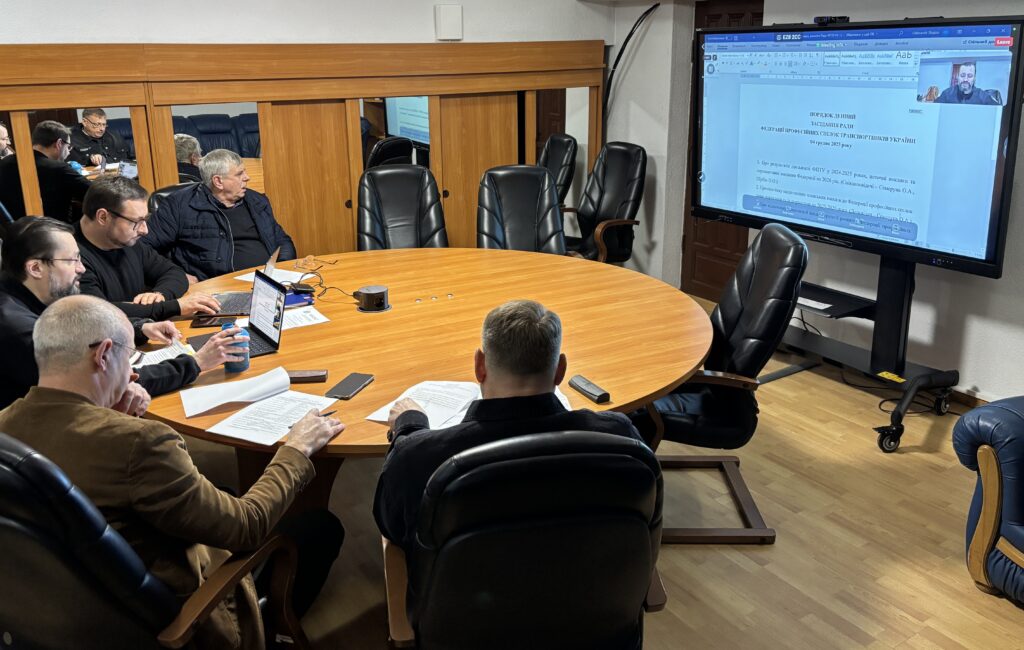
The meeting began with a tribute to the memory of transport workers who gave their lives defending the country on the front lines and conscientiously performing their duties behind the scenes.
“Hundreds of thousands of Ukrainian workers took up arms for the first time and joined the ranks of the Armed Forces of Ukraine. Millions continue to work on the labor front, providing a strong economic rear. Unfortunately, many of them are no longer with us.” — noted Oleksiy SEMERUN Chairman Federation (FTTU)
The transport sector in wartime: role and challenges
According to FTTU estimates, 2024–2025 were among the most difficult years in the history of the domestic transport system. Despite constant shelling, destruction of infrastructure, and high risks to workers' lives, the transport industry continued to perform strategic functions:
- provision of passenger transportation services,
- support for critical logistics chains,
- export of products manufactured by Ukrainian enterprises,
- transportation of raw materials and supplies for defense and industrial needs.
Railway workers, maritime transport workers, and employees of road and other related modes of transport, who work in conditions of constant danger, played a particularly important role.
The FTTU emphasized that during this time, as part of the work of trade unions at the national level, the Federation actively participated in the development of labor legislation for the period of martial law in order to prevent the introduction of a whole range of radical restrictive measures that employers were trying to implement under the pretext of war. The proposals made it possible to resolve some completely new issues in the Ukrainian labor market. Some of the regulations were revised, and thus the rights of workers, which had been curtailed at the beginning of the war, were partially restored. Work in this direction continues.
At the same time, the socio-economic situation of workers in the industry remains difficult – they work in extremely hazardous conditions, while receiving inadequate pay and limited social protection.
It is emphasized that wages in transport are significantly lower than wages in a number of industries or in the civil service.
According to the State Statistics Service, in the first half of 2025, the average monthly salary in the transport sector was over UAH 23,000, which is 10% less than in industry and 20% less than in public administration.
For example, at Ukrzaliznytsia, the issue of indexing freight transportation tariffs has remained unresolved for over two years. The lack of an appropriate decision directly affects the level of remuneration of employees, whose salaries have not increased since 2024. At the same time, railway workers are responsible for evacuating the population, ensuring the functioning of key routes for exports, industry, and domestic logistics, as well as the continuous provision of passenger transportation. So why not provide for the necessary expenditures in the state budget to ensure an increase in the wages of railway workers, in particular by introducing effective mechanisms to compensate for unprofitable passenger transportation? Under such conditions, a logical question arises: how much more patience should workers show in the absence of systemic solutions regarding adequate remuneration for their labor?
Legislative changes: European integration and risks
For 2026, the FTTU has identified support for and influence on the formation of legislation as a priority, in particular:
- draft Labor Code of Ukraine,
- laws on occupational safety and health,
- regulatory acts on liability for violations of occupational safety requirements,
- laws protecting workers affected by war,
- on collective labor disputes and social dialogue.
The Federation warned about the existence of political and business groups seeking to narrow labor guarantees, weaken trade union influence, and prevent the introduction of European labor standards in Ukraine.
“It is trade unions, integrated into national, European, and international structures, that are capable of protecting the interests of ordinary workers. We have professional staff, mechanisms for social dialogue, and legal instruments for collective action.” – executive Secretary - Oleksandr SHUBIN
In 2026, the Federation will also focus on renewing trade union personnel, conducting training and information campaigns, engaging young people and women, supporting veterans and workers with disabilities, and developing occupational safety systems. These areas are key to restoring the country's labor potential and ensuring the stable operation of the transport sector during the war and after victory.
The FTTU Council has set ambitious but extremely necessary priorities for the industry for the coming years. Strengthening the protection of labor rights, influencing legislative processes, and participating in the post-war reconstruction and modernization of the industry are the tasks that the Federation considers key.
“We must be the core of the industry's and country's recovery. Together, we will build a peaceful, strong, European Ukraine,” the meeting participants concluded.
 EN
EN  UK
UK